Showing posts with label Tillage. Show all posts

Saturday, August 8, 2020

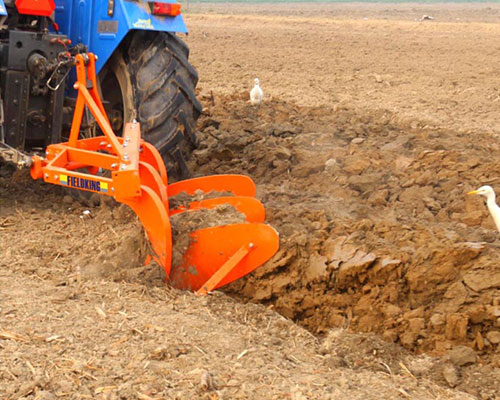
Mould Board Plough – Overview and Advantages

A mould-board plough or MB plough plays a vital role in soil management which is one of the most crucial farming operations. It is one of the most popular farm machinery used in the process of preparing the soil before sowing the seeds. An MB plough is also used for preparing the ground for grass seeding. 


The body of an MB plough or mould-board plough consists of a large curved bottom or mould-board, fixed to a frame, shears placed at the bottom edge of the mould-board while large curved wings on the top edge. It runs through the farm attached to a tractor and cuts the top layers of soil completely and thoroughly.

What are the advantages of a mould-board plough?


Some of the remarkable advantages of the mould-board plough are given below.

  • Efficiency

When adjusted perfectly an MB plough can automatically seek the desired depth and does not need to apply extra weight to attain desired depth. The complex structure of the plough clears the ground after harvesting perfectly and helps in creating a more levelled surface for sowing seeds with higher accuracy.

The plough increases the drainage capacity of the soil. A farmer can prepare a field much faster with a mould-board plough comparatively to a conventional plough. The faster ploughing helps farmers to cover larger areas of the field.

  •  Various Models for Versatility

Different types of models of an MB Plough come with different types of features ensuring high efficiency in the preparation of the land. Few models have two mould-boards or more. The width of a cut usually reaches one to two feet. Yet most of the models are able to achieve a depth of one and a half feet. Some models integrate a reset mechanism.

  • Helps in Weed Control

An MB plough buries the weeds entirely that tend to spring up after harvesting. The plough completely inverts the soil where there are weeds. This specifically helps to save the time and labor cost where weed regrowth is a frequent issue.

  •  Pest Control

The MB plough also helps to get rid of the pests inhabited on a farm. Eliminating pests provides plants with a more favourable environment for faster and healthy growth. Least presence of pests contributes to a bountiful yield.

  • Better-quality Soil Health

The MB plough buries crop remains deeper into the field enabling decomposition. Crop residues on the soil surface warm up faster by reduction of the crop residues. Evaporation of excessive moist or water is also improved providing a more favourable environment for soil to observe natural elements like sun and air making to make it more fertile.

Wednesday, July 29, 2020

Tractor Rotavator – An Overview and Advantages

The use of farm equipment does not only increase the value of production but also saves time and improves the quality of the harvest. The modern farm equipment is used everywhere in farming operations from cultivation, seedbed preparation and harvesting. Tilling the soil is one of the most important operations performed in agriculture for loosening the upper layer of soil, to make seedbed and mix fertilizer in the soil, removing the weeds and old crops residue. 


It is important to improve the soil structure before sowing seeds for healthy crops. With the help of different types of tillage equipment, the organic nutrients and other components of the soil are improved.


Ploughing the field using a mould-board plough is one of the most traditional ways of ploughing. Through the ploughing, the soil is deformed and pitched to the furrow end. However, the traditional method of the ploughing is not enough, as the upper layer is not modified in the desired structure, thus needed some additional operations like disking, harrowing and cultivation with the use of tractor cultivator, disc harrow etc. 


The steps are also known as primary and secondary tillage to give a final finish to the soil. Tractor Rotavator or Rotary Tiller is a very effective tool for tilling the soil beating all the limitations of traditional mould-board ploughs.


What are the Advantages of Using a Rotary Tiller or Rotavator?


Once the harvesting is done of the crop, sometimes it seems difficult to prepare a perfect seedbed for another crop in the thick soils. Due to the growth of deep cracks in the soil, the traditional tilling tools such as the mould-board plough, tractor cultivators and disc ploughs are not good enough to prepare the seedbed. Clod development and crop remains are other difficulties experienced using them. But the use of a Tractor Rotavator or Rotary Tiller helps overcome all these problems. These are a few advantages of using rotavator:


·         The rotating blades or rotors have increased weight and length that enables it to cut the soil much deeper than the mouldboard plough.

·         The rotors of a Rotary Tiller make an impact on the soil surface and toss the soil upward. The rotating action of the blades breaks the clods and soil can be pulverized easily.

·         The width of the rotors ensures a long-lasting effect and reduces the cost of tilling the soil per hectare.

·         Allows quick and smooth tilling of soil for different types of crops.

·         The use of rotary tillers improves the soil fertility as the fertilizers can be easily mixed.

·         Removes weeds and crop residues effectively and completely.


Wednesday, July 22, 2020

Benefits of Zero-tillage Seed Drills in Agriculture

Use of Zero tillage and no-till seed drills has a number of advantages as it eliminates soil erosion and offers improved budget of the production. There are some significant benefits of zero tillage and no-till farming in modern agricultural practices one of these is soil protection.


Zero-tillage seed drills have offered a solution to many problems in modern agriculture but the main aim to introduce it on a large scale was to fight soil erosion in some regions. Soil as in its natural state without human influence is much more resistant to water and wind erosion. Which is why ploughing is not always fruitful in many areas but its impact is opposite on the soil. The development of a no-till seed drill followed an adaptation of existing conventional tillage seeding equipment to the specific requirement of no-till.


Farmers nowadays use a number of farm equipment to improve the efficiency ad save time and money. The seed drill not only offers higher yield and better nutrient use efficiency but also saves the time and costs when in terms of the number of rounds are decreased. Additionally, the final result for a farmer is reliable crop production with better profits.


·         Offers improved economy of production

·         Increases organic content and the quality of the soil

·         Reduces labour costs of ploughing and planting seeds.

·         Reduces other costs related to assets, farm machinery and fuel lubricants

·         Improves water balance in the soil

·         Reduces soil erosion

·         Increases percentage of plant nutrients

·         Saves and improves the environment


In order to accomplish proper farm practices with soil protection, farmers need farm machinery like seed drills that are capable of matching their requirements. It is necessary to consider all the features and functions properly to see the effectiveness of a seed drill of any brand before choosing a suitable drill for the task. The efficiency of a seed drill can be checked by the biological and economic risks of its usage for farming in any area.

Monday, July 20, 2020

Ploughing and Its Advantages

A Plough is the primary tillage equipment, used to cut, break and turn the soil partially or entirely. Ploughing is an ancient practice that is done to break the upper layer of the soil and its clods, to make it suitable for sowing new plant seeds.


This ancient farm equipment has transformed farming ways in modern times as it got improved with modern technology. Earlier farmers used human-made iron-tipped, wood wedge-shaped equipment pulled by oxen to till the soil. Modern plough such as disc plough and mould-board plough are used as an attachment to the tractor and let a farmer to plough even larger fields in minimum time. It also works very efficiently to control weeds and bury previous crop residue.


Ploughing being one the primary and most important soil management practices is used for centuries to form a grained, structural and straight planting layer on the upper part of the soil. This simple yet effective farm practice is done to cut, refine, and upturn the soil and to make furrows and ridges with the use of disc plough and mould-board plough. The use of any type of plough is decided as per the depth and structure of the soil.


Advantages of Ploughing


  • Improves air circulation inside the soil to enables the routes to respire with ease.
  • The root can enter deeper into the soil so that it can hold the crop plants firmly.
  • Ploughing increases the water-absorbing capability of the soil.
  • A Plough digs up the weeds developing in the land and helps in the growth of microbes.
  • Supports in growing worms and microbes.
  • Dig up and bury the old crop weeds.
  • Brings the nutrient-rich soil to the upper layer of the soil so that the crop can use those nutrients to grow well.


Different types of plough such as disc plough, mould-board plough, reversible mould-board plough is used in modern farming practices. The use of various types of plough in modern farming practices is making farming more profitable for farmers.


Monday, July 13, 2020

Plough – Overview, Types and Advantages

A plough is a farm implement used in agriculture for initial cultivation or tilling the soil and preparing it for sowing seeds by loosening and turning it. Ploughs were used to be drawn by animals like oxen and horses traditionally, but in recent times these are drawn by tractors. The procedure of loosening the soil for farming is known as ploughing. 

The key purpose of ploughing the soil is to turn over its upper layer, getting fresh nutrients to the upper surface, burying weeds and the remains of last crops same time to let them break down creating natural compost.

Types of Plough

Based on their need in the steps of creating a perfect seedbed, different types of plough are used in the process of ploughing the soil. These can also be divided into primary and secondary tilling tools. And a few can be used as primary as well as a secondary tool.

Disc Plough


A disc plough is compatible to work in all types of soil for the purposes of breaking, raising, turning and mixing it. This type of plough is mostly used in hard, dry and trashy land conditions and where scouring is a major problem and can be directly mounted to the tractors.

Mould-Board Plough

Using Moldboard plough provides soil pulverization and buries the weed seeds and residue completely. A Mould board plough turns soil completely to bring nutrients to the surface. The mould-board plough reduces the amount of time required in preparing a field significantly, as a consequence, allowing a farmer to work a larger piece of land in less time.

Rotary Plough or Rotavator

Also known as Rotary tiller in various parts of the world, a Rotary plough or Rotavator is compatible to work with different soil conditions and applications. Its rotating blades or rotors loosen and aerate the soil to ensure a perfectly levelled and finished seedbed. This piece of tillage equipment is quite popular as modern farm equipment among farmers.

Chisel Plough

Chisel Plough and subsoiler are used as deep tillage equipment to break up hardpan and packed soils.

Advantages of ploughing the Soil:

These are the advantages of ploughing the Soil:

  • ·         Loosening of the soil improves its quality by exposing it to the sun and increasing air circulation.
  • ·         The roots can enter deeper into the soil that allows it to hold the plant firmly.
  • ·         Ploughing enhances the water preservation capacity of the soil.
  • ·         Ploughing helps in uprooting the weeds growing in the field and supports the growth of microbes.


Tuesday, July 7, 2020

Tillage Equipment & Machinery– An Overview and Uses

Tillage is the term that refers to modification of soil properties for crop production. Tillage equipment is tools used to manage soil before planting seeds.


We can say that the process of preparing of land before sowing seeds is called tillage. And in this process a farmer uses various farm equipment to modify the soil properties, these equipment are known as tillage equipment. Tillage is required to provide the plants natural nutrients for an ideal growth.


Nowadays farmers use various tilling methods and equipment like plough, mould-board plough, rotavator or rotary plough, disc harrow, seed drill, cultivator, planters etc. The use of such modern tillage equipment helps farmer reduce time and accomplish ploughing in largest lands in minimum time. Here we are going to discuss some of the modern agricultural machinery used in tillage for smooth operations.


Mould Board Plough


A mould-board plough is mostly or commonly used in heavy rain or canal irrigated areas where the weeds grow-up easily. The main purpose of using a mould-board plough is to invert and pulverize the soil completely by breaking the clods in soil. It also digs up the roots of weeds, crop residues and trash and buries them under the surface where they convert in organic compost.


Power Harrow


A Power harrow is used to break, turn, refine and level the soil all over the farming area to turn it into a perfect seedbed. A power harrow is a significant piece of agricultural machinery used in tillage which is capable of working in even the harshest and most solid grounds when it comes to preparing a perfect land for plantation.


Disc Seed Drill


This versatile farm machinery is used for spreading seeds and fertilizer in the fields. The disc seeds drill consists of multiple boxes to store seeds and fertilizer and is attached with tubes. The tubes are used to spread crop seeds directly into the soil with comparatively less disturbance in the soil.


Rotavator or Rotary Tiller


Rotavator also known as a rotary tiller or rotary plough is a piece of tillage equipment used for deep tillage. It turns, mixes and aerates the soil to increase its nutrients count, making it perfect for seeding and harvesting. A rotavator consists of an assembled set of rotating blades or rotors connected to the engines that break through the soil and turn it.


Monday, June 1, 2020

Modern Tillage Equipment for Contemporary farmers


Before a farmer plant a new crop, he needs to first till the land. New improvements in conservation and proficiencies have created additional options than earlier, as farmers use modern farming methods and equipment to get the most from their land.


Modern Tillage Equipment

New tillage equipment for effective and efficient tilling such as disc plough, mould-board plough, disc harrow and rotavator have come in the market as new technology advances that are designed to break up, mix, level soil, even in heavy crop residue areas. Some of these we have explained here -

Plough – Various plough such as disc plough, mould-board plough, chisel plough is the most modern equipment when it comes to discussing most modern tilling tools. A moldboard plough is most suitable for breaking many soil types for turning and covering crop residues. Various designs are intended to function best for some specific tasks in specified soil conditions. The part in a mould-board plough that breaks the soil is known as bottom or base and includes share, the landside, and the moldboard. The share works as the cutting edge of the moldboard plough.

Rotavator or Rotary Tiller - Used for stirring the soil at depths, a rotary tiller is equipment generally used for deeper primary-tillage operations. In some areas, however, this is used for secondary tillage.

Harrow – Known as secondary tillage equipment it is used to improve the seedbed by increasing soil pulverization, to conserve moisture by destructing weeds, and cutting crop residues. The process of making final seedbed is accomplished by the use of various types of harrows like disc harrow, power harrow, heavy-duty hydraulic harrow, compact model disc harrow, offset disc harrow etc.

Seed Drills or Seeders – These are the equipment used in areas where minimum to zero-tillage is required due to the risk of soil erosion. No-till is actually is considered as the best tillage practice for conserving water. Another reason for using no-till equipment is that while performing tillage or deep ripping, the pores created by earthworms and microorganisms that serve as a conduit for water to go down deep into the soil are destroyed. It reduces the water-absorbing capacity of the soil, causing erosion. Most common no-till equipment are disc seed drill, zero till drill or planter.

Above mentioned a few to mention as most modern agricultural machinery that helps farmers in increasing efficiency of their farm